
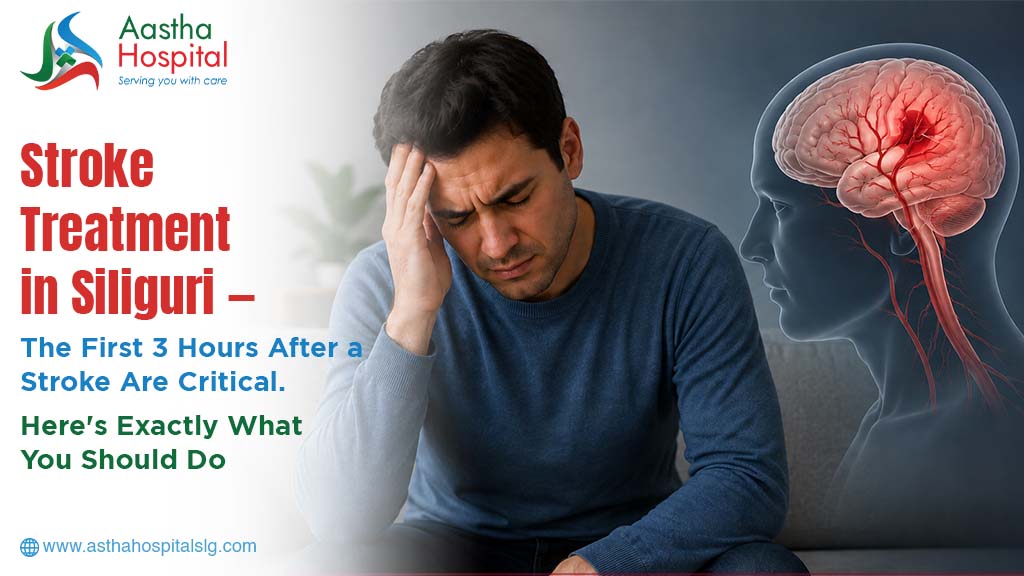
One moment, everything is normal. The next — one side of the face droops, an arm goes weak, words stop coming out right.
That is a stroke. And what happens in the next three hours can be the difference between full recovery and permanent disability. Or worse.
In India, most people waste their valuable time not recognising it, not knowing. They do not know how to proceed or are just ‘waiting to see if it gets better.’ It just does not. A stroke is an emergency requiring immediate attention and for those in Siliguri and knowing how and where to act could one day save their lives or those of a loved one.
What Is a Stroke and Why Is Time the Most Critical Factor?
A stroke occurs when the blood supply to a part of the brain is interrupted, either because an artery is blocked (ischaemic stroke) or because a blood vessel has burst (haemorrhagic stroke). Once the blood stops flowing to brain cells, the cells die. Quickly.
Doctors use a phrase that captures the essence of the illness perfectly: ‘Time is brain.’ When each minute goes by without a stroke patient receiving treatment, almost two million brain cells die. For every hour without treatment, the brain ages by around 3.6 years.
This is why the cornerstone of the management of acute stroke is centred on one priority above all others – speed.
There is often a relatively short window during which it is possible to administer the most effective treatments. The faster the patient arrives at a centre to obtain stroke treatment in Siliguri, the greater the chance of recovery.
Recognise a Stroke Immediately — Use the FAST Method
Before anything else, you need to know how to spot a stroke. The FAST test is the fastest way:
F -Face : Ask the person to smile. Does one side of the face droop?
A -Arms : Ask them to raise both arms. Does one arm drift downward or feel weak?
S -Speech : Ask them to repeat a simple sentence. Is their speech slurred, confused, or impossible?
T -Time : If you see any one of these signs, call for emergency help immediately and note the exact time symptoms started.
Other warning signs include sudden severe headache with no known cause, sudden vision loss in one or both eyes, sudden loss of balance or coordination, and numbness on one side of the body.
Do not wait to be sure. Do not give them water or food. Do not let them sleep it off. Act immediately.
The First 3 Hours — What Should Actually Happen
The doctor should see a stroke patient and start a neurological assessment within the first 10 minutes of the patient being at the hospital.
A CT scan or a brain imaging should be carried out within 25 minutes. This informs the doctors of the stroke being ischaemic (blockage) or haemorrhagic (bleed) – as the treatment of the two is entirely different.
Treatment ought to ideally commence within 60 minutes -the Golden Hour.
That is why it is extremely important to select the appropriate hospital. All facilities in North Bengal do not have the equipment and trained specialists to operate within such windows. In the event of an emergency like this, Aastha Hospital in Siliguri is well prepared.
Treatment of Stroke
The type of stroke and how quickly the patient receives medical treatment influence how the stroke is managed. In ischemic stroke, physicians may prescribe clot-busting drugs and surgery to get the blood flow back into the brain; for hemorrhagic stroke, physicians may prescribe drugs to reduce bleeding and relieve pressure within the brain. Hospital treatment is a very important aspect in the treatment of all stroke patients. For any stroke treatment in Siliguri, you can visit multispeciality hospitals like Aastha Hospital.
Thrombolysis: The Clot-Busting Treatment
In the case of the most common type of stroke, ischaemic stroke, thrombolysis (a clot-dissolving drug administered via a vein) is the main treatment.
This medication is known as tPA (tissue Plasminogen Activator). It acts by dissolving the clot that is obstructing the blood supply to the brain. Administered within 4.5 hours after the onset of symptoms – and preferably in the first 3 hours- it stands a much better chance of success.
Time is of the essence when it comes to treating thrombolysis. Once the window has been closed, this treatment can not be safely administered anymore. This is among the reasons why the initial few hours cannot be substituted.
Thrombolysis is not available at all hospitals. It involves trained neurologists, adequate imaging facilities, and a rapid response.
Mechanical Thrombectomy -Where the Clot Must be Directly Removed
In larger clots, which are non-responsive to medication, or when the patient presents beyond the thrombolysis window, mechanical thrombectomy is the treatment of choice.
This is minimally invasive and involves the insertion of a thin catheter into an artery (typically into the groin) and directed to the blocked vessel in the brain. The clot is then dislodged or removed by a device, which restores normal blood circulation.
Mechanical thrombectomy has a wider treatment window – extending up to 24 hours in specific patients – and demonstrated impressive outcomes even in severe stroke cases. Patients who presented without the ability to move or speak have left the hospital having undergone a successful thrombectomy.
It is a complicated treatment that involves skilled interventional neurology and imaging facilities. It is the most advanced stroke management and care currently.
Emergency: What to Expect? Stroke Rehabilitation
The first step is to survive a stroke. The more difficult journey is recovery.
There are general plans that the post-stroke care should focus on a team of neurologists, physiotherapists, speech therapists, and occupational therapists that work to restore the patient to as normal a state as possible.
Early rehabilitation starts between 24 and 48 hours of stabilisation. Early rehabilitation has already been established to be very effective in improving results, lowering long-term disability and earlier restoration of patients to independent life.
With an efficiently prepared centre in Siliguri, stroke victims in North Bengal, Darjeeling, Jalpaiguri, Cooch Behar and even in some areas of the Northeast do not have to travel to Kolkata or farther in search of quality services.
Risk Factors You Should Know About
The elderly are not the only ones to have strokes. Stroke is increasingly being observed in individuals who are as young as their 40s and 50s of age and in other cases, even earlier.
The predominant risk factors
- uncontrolled high blood pressure (the largest one)
- Uncontrolled diabetes,
- Elevated cholesterol,
- Smoking
- Excessive alcohol consumption
- Excessive body weight
- Irregular heart rhythm (atrial fibrillation)
- A sedentary lifestyle.
The positive news is that there is a possibility of preventing up to 80 per cent of strokes with the appropriate change of lifestyle and medical management.
Checkups, being familiar with your blood pressure, and being in control of chronic conditions have a very long way to go.
Why Is Aastha Hospital the Best Choice for Stroke Treatment in Siliguri?
When you have a stroke, the hospital you arrive at during those initial vital minutes determines everything to come.
Aastha Hospital, a multispeciality hospital in Siliguri, has been serving comprehensive care to patients since 2021. It is a stroke-specific facility with facilities and capabilities to respond promptly. You receive the most effective Stroke Treatment in Siliguri.
- Advanced Stroke Care Facilities: Aastha Hospital incorporates modern diagnostic and emergency care facilities. It provides quick and accurate stroke treatment. Effective medical help and professional treatment enhance the chances of recovery.
- Experienced Neurologists and Medical Team: We have an experienced team who are always there to offer holistic and comprehensive care to the patients.
- Emergency services: Stroke requires 24/7 Emergency Support. You get emergency services at Aastha Hospital. It guarantees timely treatment with no delay.
- Personalised Patient Care: Each patient is different from others. Their requirements are unique. Therefore, everyone receives personalized treatment.
- Rehabilitation and Recovery Support: Aastha Hospital also supports rehabilitation and follow-up care for stroke patients. ensuring their better recovery and enhanced quality of life post-treatment.
Frequently Asked Questions (FAQs)
Q1. What is the most important thing to do when a stroke happens?
Q2. Can a young person have a stroke?
Q3. What is the difference between thrombolysis and mechanical thrombectomy?
Q4. Is stroke treatment available in Siliguri or do I need to go to Kolkata?
Q5. How long does stroke rehabilitation take?
A Stroke Can Happen to Anyone. Will You Be Ready?
Most families are not prepared. They panic, they delay, they go to the wrong hospital. And those lost minutes cost everything.
And because, at Aastha Hospital, they know a thing: that in a stroke the clock never stops ticking.
Every Second Matters -Here Is What You Must Do Right Now
A stroke does not give you time to think. But you can prepare before one ever happens.
Do these three things today -before an emergency strikes:
Save Aastha Hospital’s emergency number in your phone right now. Not later. Not tomorrow. Now. When a stroke happens, you will not have time to search. Having the number ready could save a life -possibly your own.